Day 1. September 2, 2004 (Thursday) I arrived in Frankfurt at 9.30 a.m., zipped through customs, found Kevin ready and
waiting, and
by 10 we were on the way to Metz. We reached the border and called Pierre at noon and were in
Metz by 1.15 or so, taking some time to find a phone card so we could called Pierre again. We
went to Le Loft (opposite the train station) for lunch; Pierre met us there at about 2. After lunch
we went to the cathedral at Metz (a warmish walk; it was close to 90 degrees or maybe more).
We saw the famous Chagall windows (2nd
image) and the
very fine west front. and then drove to Nancy. We checked in about
5.30 (no difficulty finding the hotel); Kevin went off to write postcards and I took a nap. About
7.30
we sent off to walk through town and find dinner (Best Western Crystal). This is the Place Stanislas, which we saw in the last glow of the day.
Day 2. September 3, 2004 (Friday)
We set off very early and were on our way by 8. Our first stop was Vieville-en-Haye, a
small town on the way to Thiacourt. This is a photo of Kevin next to
a marker saying that the town was taken Sept. 12, 1918, and that the US front was 3 miles north
of this line. I see now by the map that had I been a sharper and more practiced reader I'd have
seen two cemeteries we had already passed up, one in Feye-en-Haye and the other in Vieville
itself. The first cemetery we saw was the German one at Thiacourt. (My pictures there are 5469-75.) We then went to the
Thiacourt memorial, near the "mairie" or town hall, which was
flying
the US flag and French flags, which we were pleased to see.
Then we found the large American cemetery, looking magnificent in the bright sunlight, with workers redoing the main path (these are 5482-93;
here for information on all the US military cemeteries). There are
great bronze doors (close-up), and
plenty of material here for a second visit, if Kevin is game, to the Aisne / Chateau-Thierry area,
which
we skipped. On from en route to to Montsec, the US memorial at the top of the hill that gives an
overview of the entire St. Mihiel salient, we stopped for the remarkable monument at Richecourt
(5494-95; it was 10.30). At Montsec we saw someone repainting the
mock-up of the salient
(#5493-5506); there were great views. We went to the town of St.
Mihiel, where we had lunch
(starting with 5507-09; 11.30 a.m.). After lunch we stopped briefly for a memorial to the civilian
victims at Rouvrois-s.-Meuse (5510-11).
We settled in (or rather I did) for the trip ito Verdun; the first picture is of Kevin in a trench (I did the same)
(5512) en route to Fort Vaux. We saw the interior, then quickly went to Douamount and, near the
ossuary, saw the huge French cemetery. I also took an unsettling
picture of the ossuary as seen from outside (last picture is 5522).
The route to Montfaucon was long and indirect. It's south and east of Romagne and not easy
to find (5523-27). I must have run out of steam
here and been somewhat overwhelmed by the scale (14,246 dead) because I took few pictures of
the central memorial area, even though it was quiet. I have several
photos of graves, including some of the civilian graves there. But there seems to have been a trade-off between my
experience of the place and my ability to fix it (or try to) in pictures.
We ended the day at Reims, drawing up to the cathedral just as
the last rays of the sun were turning it a lovely pink. In my last photo
(they are 5528-36) the color has just gone out of it and the place looks rather blank. Kevin and I
both remembered Wharton's amazing description of the front of the cathedral after it had been
shelled and burned by the Germans (Fighting France), the many colors of the facade; she
expected that the stone would all collapse with the fall rains, but she was wrong; certainly most of
the statues there (some are very badly damaged) are original. I forgot to show Kevin the bullet
holes on one side of the church; I recall that Tim noticed them in 1999.
Day 3. September 4, 2004 (Saturday) From Cerny we went to Laon, where I foolishly
misidentified some little church at one end of the town for the
cathedral, much to K's amusement (5562-64). We found the cathedral at last (5565-71); I took 4 pictures of the railyards (strategic
importance, obviously 5572-75).
There are photographs from two places outside Laon. At Bezny-et-Loizy we stopped at a
small French cemetery (5576-77); then we went on to Vivaise
(5578-79), which we though was full of flowers and unusual because it is a painted Poilu memorial. We skipped St. Quentin (Wister says he could see
the holes the Germans had drilled in the pillars of the cathedral, planning to blow it up) and
Peronne (both important to me for their role in the Hundred Years War) and went through Albert
(K glimpsed the famous once-handing madonna) to Thiepval and the huge memorial there
(pictures 5590-98).
On the way to Thiepval we stoppd at Pozières, a solemn,
impressive, blindingly white memorial and cemetery (#5687-89). I am not sure
where we saw the next one--and not sure that a map will help, although the pictures are
time-stamped and I
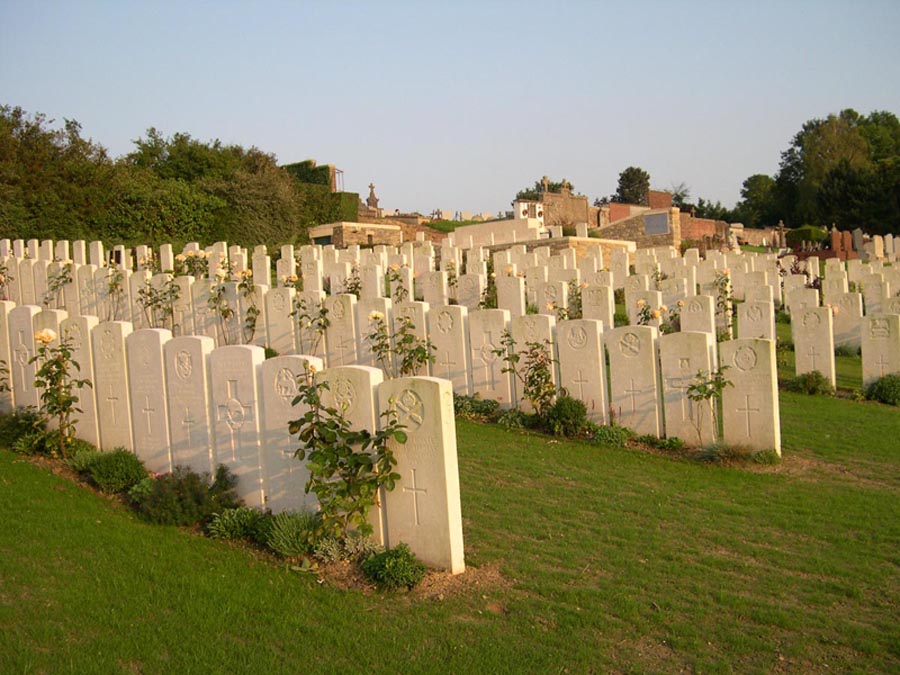
can get some idea from that. This was the British cemetery at Bray-sur-Somme, where we found graves very
close
together and some Indian graves at one end. It was a distinctive place and it was used for
front-line burials in 1917. The closeness of the graves means, I think, that although they know
who is buried in the cemetery, they do not know exactly whose body is whose. The cemetery was
on both sides of the front at one time or another and was no doubt blown up many times, making
more exact identification impossible. The shoulder-to-shoulder gravestones are silent testimony,
then, to a disturbing fact. I am reminded that at Vendresse we saw several tombstones along the
outer wall with the names of British soldiers who had been buried near a church that had been
destroyed and that their bodies could not be accounted for.
We stoped a while at Thiepval, unforgettably huge, ugly, serious,
with a French-English cemetery behind it and a new visitors' center
(where Kevin bought a big book of war pictures). The next pictures are of the Newfoundland site
at
Beaumont-Hamel, where we had another great view of Thiepval (you
have to look closely at the background to find it) and where we made a quick tour of the trenches in beautiful late-afternoon light (5599-5606).
Then we made
the drive to Doullens, not much of a place. But I was glad to find that the cemetary there held
dead from the hospital mentioned by Wharton and Wister (5607/8-14). There is a section of
graves for the Germans who died there. I had though that I had
photographed the graves of the nuns who were superiors at the hospital--one died in 1917, I
remember, one I think in 1923--there were 4 of them). We guessed that the hospital is now a
recreational facility for families on welfare, but I don't know). That was it for the second day until
we got to Arras and took pictures of the carnival outside the hotel window (5615-27). We think
this was connected to VE Day, which is Sept. 5 or 6. There was a celebration pending for the
60th anniversary of the liberation of Laon, as I remember.
Day 4. September 5, 2004 (Sunday) Day 5. September 6, 2004 (Monday) That's it. No more pictures (5645-56)--except Kevin outside his
apartment Monday as we left for the station and my train to the Frankfurt airport--and a very
good picture it is. October 11, 2004, with some notes August 13, 2005 Register of pictures (all downloaded to hard drive).
Day 1 5446 to 5536
Day 2 to 5536 to 5627
Day 3 to 5627 to 5656